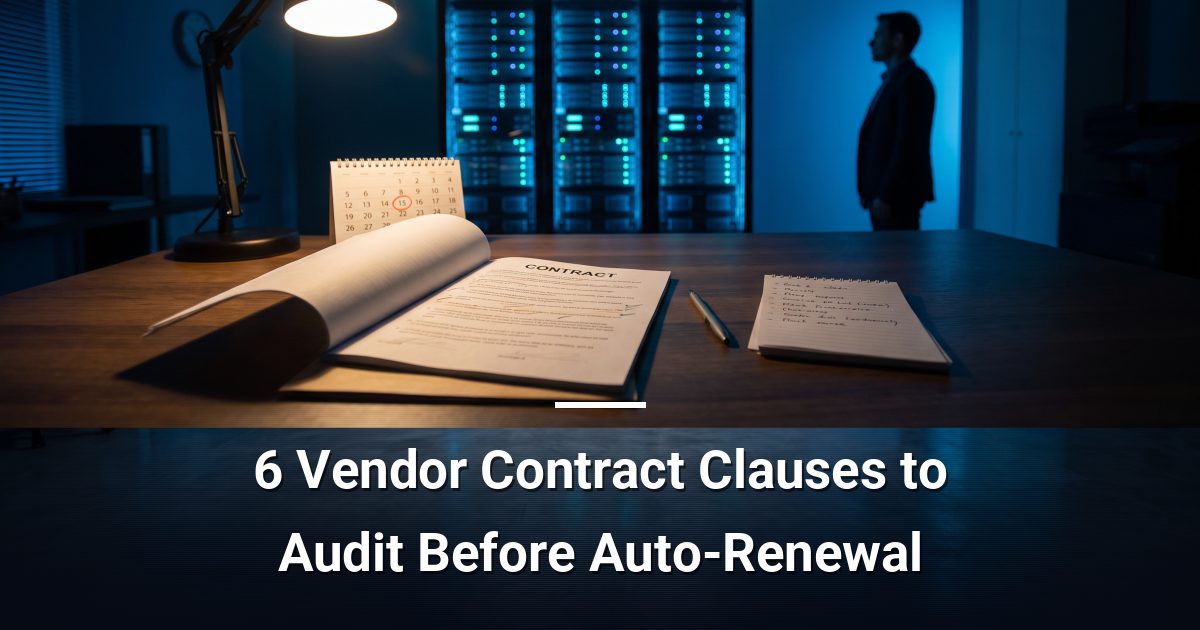
6 Vendor Contract Clauses to Audit Before Auto-Renewal
A vendor contract review before auto-renewal prevents surprise costs and lock-in. Check these 6 clauses before your next renewal date.
Key Takeaways
- Auto-renewal clauses can bind you to another full year if you miss the cancellation window by even one day.
- Pricing escalation terms buried in contracts can raise your costs significantly without any renegotiation.
- Service level agreements only protect you if they include measurable targets and real remedies for non-performance.
- Data ownership clauses determine whether you can export your information cleanly when a contract ends.
- Setting a 90-day calendar reminder before each renewal date gives you enough time to negotiate or exit.
A thorough vendor contract review — checking renewal windows, pricing terms, performance standards, and exit conditions — is the most reliable way to avoid unexpected costs and unwanted commitments when a contract quietly rolls over for another year. Done 90 days before the end date, it gives you real leverage.
Why Does Auto-Renewal Catch Most Organisations Off Guard?
Most vendor agreements include an auto-renewal clause that extends the contract — often for a full year — unless you provide written notice within a specific window, sometimes as short as 30 days before the end date. Missing that window by even one day can obligate you to another 12 months of fees. A systematic review, done well in advance, is your only reliable defence.
How Do You Find Every Contract Due for Renewal?
Before you can review anything, you need a complete picture. Pull together every active vendor agreement — software licences, IT services, telecoms, equipment leases, facilities contracts — and record the end date and notice period for each one in a single spreadsheet. Set a calendar reminder 90 days before each renewal date. That is your review window.
The 6-Point Vendor Contract Review Checklist
1. Auto-Renewal and Notice Period
Confirm the exact date by which you must send written notice to cancel or renegotiate. Note the required format — email is not always sufficient; some contracts require registered mail.
2. Pricing and Rate Escalation Clauses
Look for language that permits the vendor to increase fees annually, often tied to a consumer price index or at their sole discretion. An unchecked escalation clause can raise your costs substantially over a multi-year term without any renegotiation. Know the cap, if any, and decide whether it is acceptable before you let the contract roll over.
3. Scope of Services
Verify that what the contract describes still matches what you actually receive — and what you actually need. Services you no longer use but are still paying for are a common source of wasted spend. If your requirements have grown, confirm the current scope covers them.
4. Service Level Agreements
An SLA defines the vendor's performance commitments: uptime guarantees, response times, resolution targets. At renewal, check whether the SLA includes:
- Measurable targets with specific percentages or timeframes
- Credits or remedies if those targets are missed
- A clear process for logging and escalating performance issues
If the SLA contains no meaningful remedy, it offers little practical protection regardless of what it promises.
5. Data Ownership and Portability
Confirm that your data remains yours throughout the contract and after it ends. The agreement should specify the export format and the timeframe within which the vendor must provide your data upon termination. Vague data ownership language is one of the most common and costly oversights in vendor agreements.
6. Termination and Exit Conditions
Review what it actually costs to leave. Look for early termination fees, minimum commitment periods, and obligations to return or destroy equipment or data. Confirm whether you can terminate for cause — such as repeated SLA failures — without penalty.
What Should You Do With What You Find?
For each contract, make one of three decisions: renew as-is, renegotiate before renewal, or give notice to cancel. Where you choose to renegotiate, go in with specific asks — a capped escalation clause, an improved SLA remedy, or a shorter renewal term — rather than a general request for better terms. Vendors respond better when they can see you have done the work.
Ready to Apply This to Your IT Vendor Agreements?
IT service and software contracts often carry the highest costs and the most complex exit conditions of any vendor category. If you would like a second set of eyes on your IT agreements,
Darryl Cresswell
CEO & President
MYDWARE IT Solutions Inc.