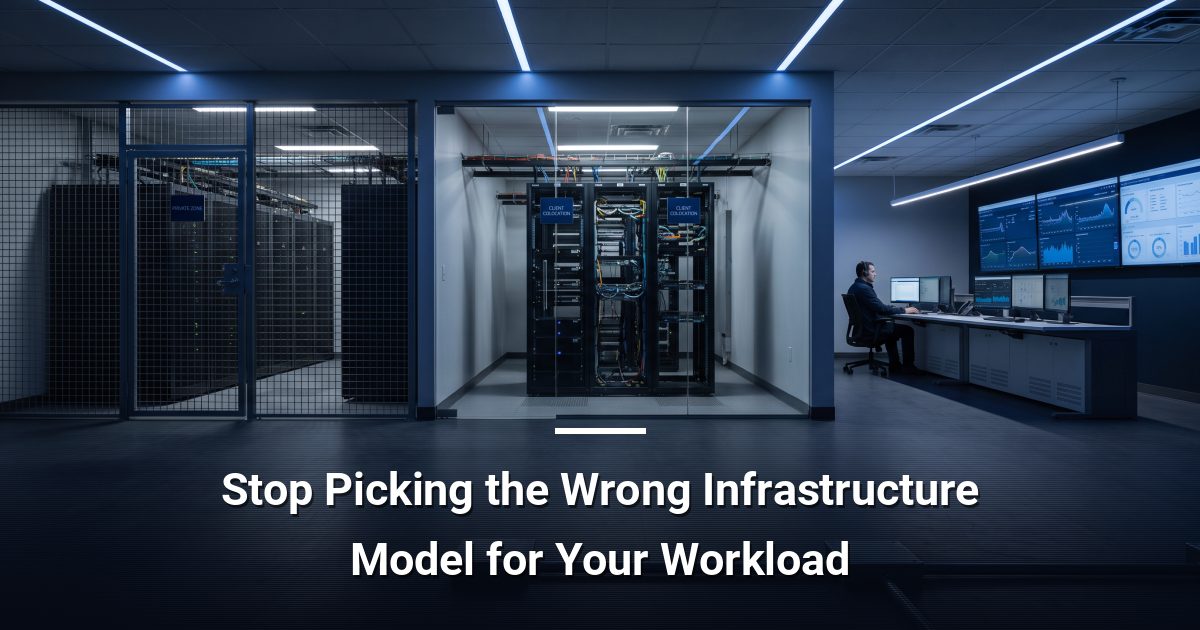
Stop Picking the Wrong Infrastructure Model for Your Workload
An infrastructure model comparison that cuts through the noise: on-premise, colocation, or cloud — here's how to match each option to your workload and growth stage.
Key Takeaways
- On-premise gives full control but requires capital investment and qualified IT staff to maintain hardware reliably.
- Colocation reduces facility overhead while keeping your equipment physically separate from shared cloud tenants.
- Cloud infrastructure scales quickly, but sustained high utilisation can make it costlier than owned hardware over time.
- The right infrastructure model depends on data sensitivity, budget structure, and how predictable your capacity needs are.
- Many organisations run a deliberate hybrid, splitting workloads across two or more infrastructure types for good reason.
Choosing the right infrastructure model — on-premise, colocation, or cloud — means matching how you store and run your systems to your actual workload, budget structure, and growth trajectory. Getting this wrong locks you into unnecessary costs or operational constraints that compound over time. This infrastructure model comparison will help you decide clearly.
What Does Each Infrastructure Model Actually Mean?
These three terms get used loosely, so a clear definition helps before you make any decision.
- On-premise: Your servers and storage sit in your own facility. You own the hardware, manage it, and bear full responsibility for uptime and security.
- Colocation: You own the hardware, but it lives in a third-party data centre. You rent rack space, power, and connectivity. The facility handles physical security and environmental controls.
- Cloud: You rent compute and storage capacity from a provider. You own no hardware. Resources scale up or down on demand and you pay for what you consume.
Why Does the Wrong Choice Cost So Much?
Each model carries a different cost shape. On-premise front-loads capital expenditure — hardware, licensing, physical space, and the staff to run it. Those costs are fixed whether your systems are busy or idle.
Cloud converts that into an operating expense, which feels lighter at first. At sustained, high utilisation, however, monthly cloud bills can exceed the amortised cost of owned hardware within a few years.
Colocation sits in between: you carry hardware acquisition costs, but you eliminate facility overhead and gain better connectivity than most offices can provide.
How Do You Match the Model to Your Workload?
Choose on-premise when:
- Your workload is stable and predictable, with no significant spikes.
- You handle highly sensitive data subject to strict regulatory requirements and want physical custody.
- You already have qualified IT staff on payroll to manage infrastructure day to day.
Choose colocation when:
- You need enterprise-grade power redundancy and connectivity your office cannot provide.
- You want physical control of your hardware without managing a data centre facility yourself.
- Latency to your own systems matters, but cloud vendor lock-in is a concern.
Choose cloud when:
- Your capacity needs fluctuate — seasonal spikes, project-based compute, or rapid growth.
- You want to eliminate hardware refresh cycles and capital planning for infrastructure.
- Your team lacks in-house expertise to manage physical servers reliably.
What About a Hybrid Approach?
Most organisations eventually run more than one model at the same time. A common pattern: keep sensitive, stable workloads on-premise or in colocation, and run variable or development workloads in the cloud. The key is deliberate placement — not a hybrid that grew by accident as teams made independent decisions.
Accidental hybrids create shadow IT, inconsistent security controls, and billing that nobody fully understands. Intentional hybrids require a clear inventory of what runs where and why.
Which Financial Questions Should You Ask First?
Before settling on a model, work through these honestly:
- Do you prefer capital expenditure (own assets) or operating expenditure (pay monthly)?
- How predictable is your compute demand over the next three years?
- Do you have, or can you afford, dedicated IT staff to manage physical hardware?
- What are your regulatory obligations around data residency and physical access?
Your answers will rule out at least one model immediately and often point clearly to a primary choice.
Ready to Make the Right Infrastructure Decision?
If you want a structured review of your current environment and a clear recommendation on which infrastructure model fits your workload and growth stage, book a risk and infrastructure assessment with MYDWARE — we work with organisations across the GTA and Simcoe County to build IT environments that are secure, cost-effective, and built to scale.
Darryl Cresswell
CEO & President
MYDWARE IT Solutions Inc.