Single-Tenant vs Multi-Tenant Cloud: Which Fits Your Data?
Cloud tenancy determines who shares your infrastructure. Understand single-tenant vs multi-tenant environments and what each means for privacy, performance, and compliance.
Key Takeaways
- Multi-tenant cloud shares physical infrastructure across many customers, separated only by software controls.
- Single-tenant cloud gives you dedicated hardware, eliminating shared attack surfaces and the noisy neighbour effect.
- Performance in multi-tenant environments can fluctuate when neighbouring tenants spike their resource usage.
- Regulated data — health records, financial files — often requires single-tenant or private cloud to meet compliance obligations.
- A hybrid approach lets you use multi-tenant cloud for general workloads and dedicated infrastructure only where it matters.
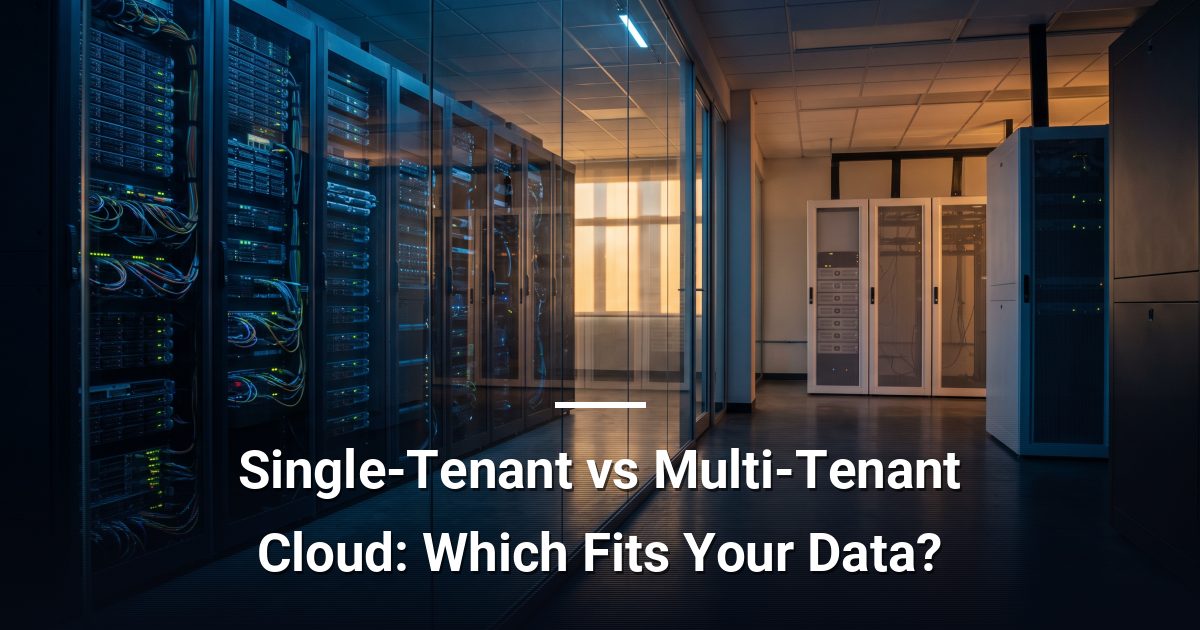
Cloud tenancy describes how your data is hosted relative to other organisations on the same platform. In a multi-tenant environment, multiple customers share the same physical servers, kept apart by software controls. In a single-tenant environment, your organisation gets dedicated infrastructure that no one else touches. The model you choose directly shapes your privacy, performance, and regulatory exposure.
What Is Multi-Tenant Cloud?
Multi-tenancy is the default for most public cloud services. Think of it like apartments in a building: each unit is locked, but the plumbing, electrical systems, and hallways are shared. Your data is logically separated from others, but the underlying hardware is not.
This model is cost-effective and easy to scale. Providers spread infrastructure costs across many customers, which keeps prices low. For many workloads — a website, a shared document library, general email — multi-tenancy is entirely appropriate.
The trade-offs are worth understanding:
- Noisy neighbour effect: A spike in another tenant's usage can slow your applications.
- Shared attack surface: A misconfiguration in the platform's isolation layer could, in theory, expose data across tenants.
- Limited customisation: You configure only what the provider allows. Deep infrastructure changes are off the table.
What Is Single-Tenant Cloud?
In a single-tenant environment, your organisation is the only customer on that physical hardware. The servers, storage, and networking are yours alone — either managed by a provider on your behalf or hosted in a private data centre.
This model offers the strongest isolation available in cloud computing. There is no shared attack surface with other customers, and performance is predictable because no one else competes for the same resources.
The cost is higher and provisioning takes longer. Single-tenancy makes the most sense when you handle regulated data — health records, financial information, legal files — or when your applications require consistent, guaranteed performance.
How Does Cloud Tenancy Affect Data Privacy?
Privacy risk in multi-tenant environments is not primarily about attackers jumping between tenants. Reputable providers invest heavily in isolation controls. The real concern is compliance: many privacy frameworks require demonstrable control over where data lives and who can access the infrastructure it runs on.
If your organisation is subject to rules like PIPEDA or PHIPA, your cloud tenancy model may need to satisfy an auditor, not just a technical standard. A multi-tenant public cloud may pass that test; it may not. The answer depends on a proper assessment of your data types and regulatory obligations — not a vendor's marketing sheet.
Why Does Performance Vary Between Models?
In a shared environment, resources like CPU, memory, and network bandwidth are pooled. Most of the time this works well, because not every tenant runs at full capacity simultaneously. But peak-demand periods can create contention — your application slows not because of anything you did, but because a neighbouring workload spiked.
Single-tenant environments eliminate this variable entirely. For latency-sensitive applications — point-of-sale systems, real-time data processing, or video conferencing infrastructure — that consistency matters considerably.
How Do You Choose the Right Model?
The right cloud tenancy model depends on three factors:
- Data sensitivity: Does your data carry regulatory obligations or meaningful competitive risk if exposed?
- Performance requirements: Do your applications need predictable, guaranteed response times?
- Budget and complexity: Can your organisation absorb the higher cost and management overhead of dedicated infrastructure?
Many organisations land on a hybrid approach: multi-tenant cloud for general workloads, single-tenant or private infrastructure for anything sensitive or regulated. The key is making this decision deliberately rather than defaulting to whatever a vendor offers first.
Take Stock of Where Your Data Actually Lives
If you are unsure which cloud tenancy model your current setup uses — or whether it genuinely fits your data obligations — MYDWARE IT Solutions can help you make that determination clearly and practically. Start with a cybersecurity and cloud risk assessment to understand exactly where your data lives and what that means for your privacy and compliance posture.
Darryl Cresswell
CEO & President
MYDWARE IT Solutions Inc.