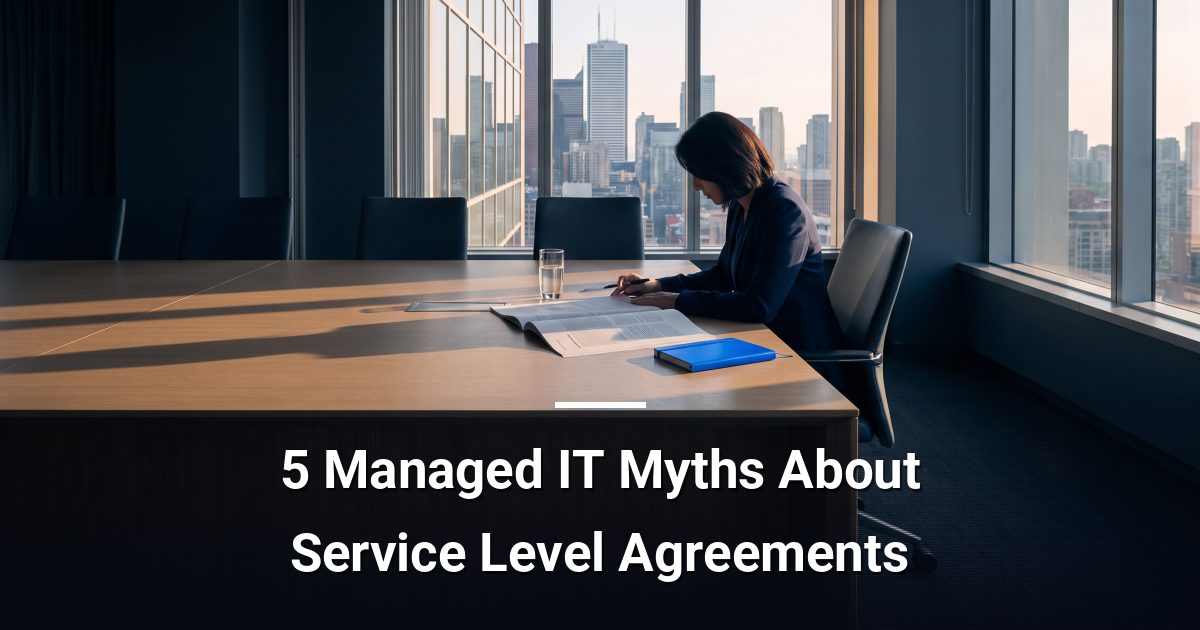
5 Managed IT Myths About Service Level Agreements
A service level agreement doesn't guarantee what most people think. Correct 5 common SLA myths and learn what to actually hold your IT provider accountable for.
Key Takeaways
- Response time in an SLA means when a provider acknowledges your ticket, not when your problem is resolved.
- Uptime guarantees typically cover infrastructure availability, not every application or end-user device.
- Financial credits for SLA breaches are often small and rarely compensate for real operational losses.
- A strong SLA defines escalation paths and communication standards, not just technical metrics.
- Read the exclusions section carefully — scheduled maintenance and third-party outages are commonly carved out.
A service level agreement (SLA) is a formal contract that defines what your managed IT provider is obligated to deliver — but it rarely guarantees what most people assume. Understanding exactly what an SLA covers, and what it deliberately excludes, is the difference between a partnership that protects your operations and one that leaves you exposed when something goes wrong.
Why Do SLA Myths Persist?
Most SLA misunderstandings come from skimming the summary page and skipping the fine print. Providers use consistent terminology across the industry, but the definitions behind that terminology vary significantly. The five myths below are the ones that cause the most friction when an incident actually occurs.
Myth 1: Response Time Means Your Problem Gets Fixed Quickly
Response time in a service level agreement means the time it takes a technician to acknowledge your ticket — not resolve it. Resolution time is a separate metric, and many SLAs do not guarantee it at all. When you are evaluating a provider, ask specifically for their average resolution times by issue category, not just their response window.
Myth 2: A 99.9% Uptime Guarantee Covers Everything
Uptime clauses typically apply to the managed infrastructure your provider directly controls — servers, network hardware, or cloud environments they host. They do not automatically cover every application you run, devices on your floor, or services hosted by a third party. Before signing, confirm exactly which systems are included in the uptime calculation.
Myth 3: Financial Credits Make You Whole After an Outage
Most SLAs include service credits — a partial refund of your monthly fee — if the provider misses a target. These credits are almost always modest and are not designed to compensate for lost revenue, staff downtime, or damaged client relationships. Credits are a contractual remedy, not a recovery plan. Your business continuity strategy needs to exist independently of whatever the SLA promises.
Myth 4: A Strong SLA Is Only About Technical Numbers
Metrics like uptime percentages and response windows matter, but they do not tell the full story. A well-written service level agreement also defines:
- How incidents are classified and escalated
- Who your named contacts are at the provider
- How and when you will receive status updates during an active incident
- What reporting you receive at the end of each month
If your SLA is silent on communication standards, you have no contractual basis for expecting them.
Myth 5: The SLA Covers Every Outage
Nearly every SLA contains an exclusions section, and it is worth reading closely. Scheduled maintenance windows, outages caused by third-party vendors, and incidents triggered by changes you made outside the provider's scope are commonly excluded from SLA obligations. This does not mean those situations will be handled poorly — it means you have no contractual recourse if they are.
How Do You Use This Knowledge Before You Sign?
Ask your prospective provider to walk you through the exclusions section line by line. Request a sample incident report so you can see how they document and communicate issues. Confirm whether resolution time targets exist and, if so, for which issue categories. An honest provider will welcome these questions — they signal that you intend to hold them to a real standard.
Ready to Evaluate Your IT Provider's Accountability?
If you are unsure whether your current service level agreement actually protects your operations, the best starting point is an independent review of your IT environment and vendor obligations. Book a complimentary risk assessment with MYDWARE and get a clear picture of where your coverage is solid and where the gaps are.
Darryl Cresswell
CEO & President
MYDWARE IT Solutions Inc.