Firewall Myths vs. Facts: What It Really Protects
Firewall protection myths put networks at risk. Discover what a firewall actually does, what it misses, and which additional controls keep your network safe.
Key Takeaways
- A firewall filters traffic at the network boundary but cannot inspect encrypted traffic or internal threats.
- Phishing emails and malicious downloads bypass firewalls entirely, requiring separate security controls.
- Endpoint protection, email filtering, and user training must work alongside any firewall deployment.
- A misconfigured firewall creates a false sense of security while leaving exploitable gaps wide open.
- Regular audits and layered defences are the only reliable way to validate your network security posture.
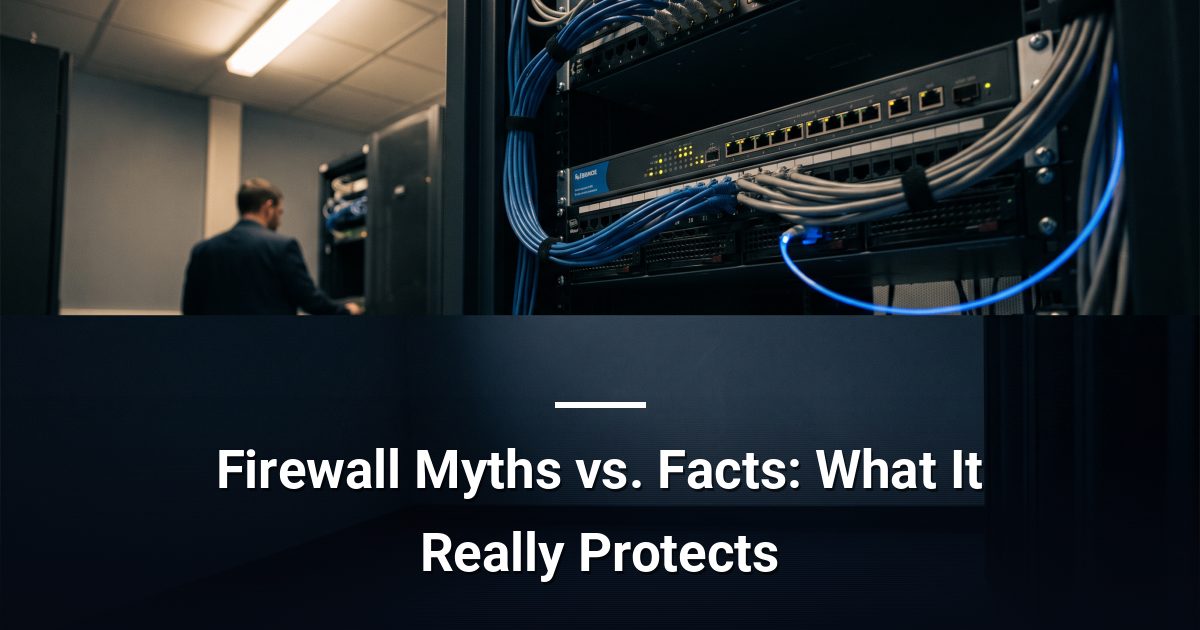
Firewall protection myths are genuinely dangerous: many organisations assume that once a firewall is in place, the network is secure. A firewall is a critical first layer — it filters traffic entering and leaving your network — but it was never designed to stop every threat on its own, and treating it as a complete solution leaves serious, exploitable gaps.
What Does a Firewall Actually Do?
A firewall examines packets of data — small units of information — as they cross your network boundary. It applies rules to allow or block traffic based on source, destination, and port (the numbered channel a service uses). Think of it as a security guard at the front door: it checks credentials, but it cannot see what is already inside the building.
Modern next-generation firewalls go further, inspecting some application-layer behaviour and flagging known malicious signatures. That is a meaningful improvement — but significant blind spots remain.
Does a Firewall Stop All Cyberattacks?
This is the most common and costly misconception. A firewall monitors traffic at the perimeter — the edge of your network. It is not designed to catch:
- Phishing emails — messages that trick employees into handing over credentials arrive through your mail server, not a blocked port.
- Malicious downloads — when a user intentionally downloads a file, the firewall generally permits that traffic because the user initiated it.
- Insider threats — someone already on your network operates inside the perimeter the firewall is protecting.
- Encrypted malware — without dedicated inspection tools, threats hidden inside encrypted HTTPS traffic pass through undetected.
Is a Hardware Firewall Enough on Its Own?
A hardware firewall at your router or server room protects the network boundary. It does not protect individual devices once traffic has passed through. If a laptop is infected via a USB drive or a compromised cloud application, the firewall never sees that threat.
Endpoint protection — security software running on each device — is a separate, essential layer. The two work together; neither replaces the other.
Why Configuration Matters as Much as Having One
A firewall with overly permissive rules — rules that allow too much traffic through — offers little more protection than no firewall at all. Common configuration mistakes include:
- Leaving default manufacturer rules in place rather than tailoring them to your environment.
- Allowing all outbound traffic without restriction, which lets malware communicate freely with external servers.
- Accumulating outdated rules over time as staff and applications change, creating unintended openings.
A misconfigured firewall is one of the most common and preventable causes of network exposure. Professional setup and periodic review are essential, not optional.
What Should Work Alongside Your Firewall?
A firewall is most effective as part of a layered security strategy. The controls that complement it include:
- Email security gateway — filters phishing attempts and malicious attachments before they reach inboxes.
- Endpoint detection and response (EDR) — monitors device-level activity for suspicious behaviour.
- Multi-factor authentication (MFA) — requires a second verification step, so stolen passwords alone are not enough to gain access.
- Security awareness training — reduces the likelihood that employees will take actions that bypass every technical control.
No single tool eliminates all risk. Layered defences are the accepted standard because each layer catches what the others miss.
Ready to Know Where Your Network Actually Stands?
Understanding firewall protection myths is the first step — but knowing whether your current configuration and layered controls are adequate requires a proper review. If you are unsure whether your firewall rules are current, whether your endpoints are protected, or whether gaps exist in your overall setup, book a complimentary cybersecurity risk assessment with MYDWARE and get a clear, honest picture of your network security posture.
Darryl Cresswell
CEO & President
MYDWARE IT Solutions Inc.