Quantum Computing Myths vs. Practical Planning Reality
Quantum computing myths are distorting real IT planning decisions. Here's what the technology can actually do today — and what still belongs in the future.
Key Takeaways
- Quantum computers cannot break modern encryption today and won't for many years.
- Most infrastructure decisions you face now do not require waiting on quantum developments.
- Post-quantum cryptography standards already exist and are worth planning for gradually.
- Hype about quantum timelines routinely overstates commercial readiness by a decade or more.
- Understanding the gap between research milestones and production-ready technology protects your planning.
Quantum computing myths are actively distorting how organisations prioritise IT investments. The technology is real and advancing, but the gap between laboratory research and infrastructure that affects your day-to-day operations is measured in years — likely decades — not months. Separating those realities is what sound quantum computing planning requires.
What Is Quantum Computing, Really?
A quantum computer uses quantum mechanical properties — superposition and entanglement — to process certain classes of problems far faster than conventional hardware. The key word is "certain": quantum machines excel at specific mathematical tasks, not general computing. They do not replace your servers, your cloud storage, or your endpoints.
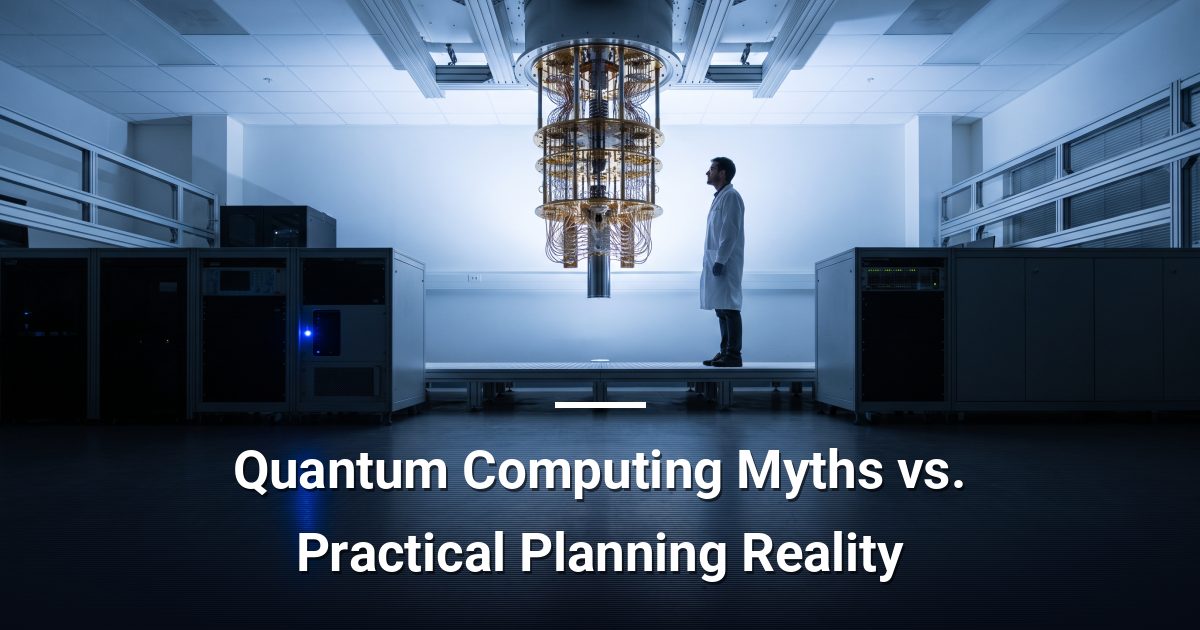
Current quantum systems require near-absolute-zero cooling, are extremely error-prone, and operate with a small number of unstable qubits — the quantum equivalent of bits. They are research instruments, not commercial infrastructure.
Myth vs. Fact: The Most Common Misconceptions
Myth 1: Quantum Computers Will Break Encryption Soon
This is the most damaging myth in practical planning. A sufficiently large, stable quantum computer could theoretically undermine certain encryption algorithms — but the hardware required does not yet exist at anywhere near the scale needed. Your current TLS connections, VPNs, and encrypted storage are not under quantum threat today. Cryptographers are already developing post-quantum algorithms, and standards bodies have published transition guidance you can follow at a measured pace.
Myth 2: You Need to Rebuild Your Infrastructure Now
No. The responsible action is awareness and gradual preparation, not emergency replacement. Organisations that remove current security tools in anticipation of quantum threats create real vulnerabilities today while solving a hypothetical problem years away. Review your encryption dependencies, flag long-lived sensitive data, and monitor post-quantum standards — that is the practical posture.
Myth 3: Quantum Computing Is Already in Commercial Use
Cloud providers do offer access to small quantum processors for research purposes. But no production workload a typical organisation runs — email, file sharing, ERP, accounting, communication — runs on or benefits from quantum hardware today. Announcements about quantum milestones describe narrow experimental achievements, not deployable technology.
Myth 4: Quantum Makes Current Cybersecurity Obsolete
This conflates a future theoretical risk with present-day operations. Your firewall, endpoint detection, multi-factor authentication, and patch management matter enormously right now. Diverting attention or budget toward a speculative quantum threat at the expense of proven controls is a planning error. Address the threats that are active today first.
Why Do These Myths Spread?
Quantum computing attracts significant research funding and media coverage. Announcements are written to highlight breakthroughs, not to contextualise how far those breakthroughs are from affecting your operations. Vendors selling post-quantum products also have an incentive to accelerate perceived urgency. Healthy scepticism toward quantum timelines is warranted — most credible researchers place broad commercial relevance well beyond the current decade.
What Should You Actually Do About Quantum?
- Identify data in your organisation with a long confidentiality lifespan — that data warrants the earliest attention as post-quantum standards mature.
- Follow the National Institute of Standards and Technology (NIST) post-quantum cryptography guidance, which has already produced finalised algorithms.
- Do not let quantum hype delay decisions about current infrastructure upgrades, security gaps, or cloud migrations that make sense today regardless.
- Ask your IT provider to flag quantum-relevant developments in annual or semi-annual technology reviews — not quarterly crisis meetings.
How Do You Build a Plan That Stays Grounded?
Good technology planning separates noise from signal. Quantum computing is a legitimate long-term consideration, but it sits behind many more immediate priorities: unpatched systems, weak authentication, unsegmented networks, and inadequate backups. Solving those problems delivers measurable protection today and also positions you well for whatever the next decade brings.
Take the Next Step With Confidence
If quantum computing myths — or any other technology uncertainty — are making it harder to prioritise your IT roadmap, MYDWARE can help you cut through the noise and focus on what actually matters. Start with a cybersecurity risk assessment to get a clear, grounded picture of where your real risks and opportunities lie.
Darryl Cresswell
CEO & President
MYDWARE IT Solutions Inc.